1 September 2006
A brief look at the famous emerald and alexandrite from Russia's Ural Mountain mines.
A brief look at the famous emerald and alexandrite from Russia's Ural Mountain mines.
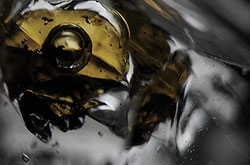
Fiber-optic lighting is one of the most useful form of lighting in the gemological laboratory. With it, we are able to see inclusions that would otherwise be invisible.
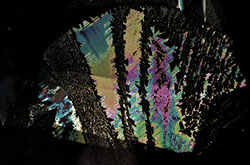
A discussion of how inclusion patterns mimic crystallographic symmetry in ruby and sapphire.

Surface ('bulk') diffusion-treated corundums (SDTCs) created a stir in the Bangkok market in 1990. This article looks at the original patents and continues through the so-called "Deep Diffusion" treatment. Identification methods are discussed, as well as the backroom politics of disclosure. At the end is a quick-reference table summarizing key identifying features of all types of natural, treated and synthetic corundums.
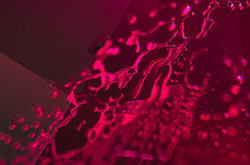
A description of the fracture healing of Mong Hsu ruby, along with the problems this has created in the gem trade.
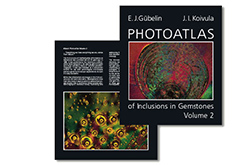
Gübelin, Eduard J. & Koivula, John I. (2005) Photoatlas of Inclusions in Gemstones, Volume 2. Opinio Publishers, Basel, Switzerland, 830 pp. ISBN 978-3855040957
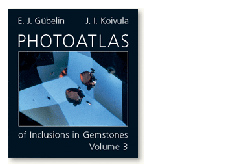
Gübelin, Eduard J. & Koivula, John I. (2005) Photoatlas of Inclusions in Gemstones, Volume 3. Opinio Publishers, Basel, Switzerland, 672 pp. ISBN 3-03999-047-4
Inclusions are among the most important features for identifying ruby and sapphire. This is the chapter on ruby and sapphire inclusions from Richard Hughes' 1997 book, Ruby & Sapphire.
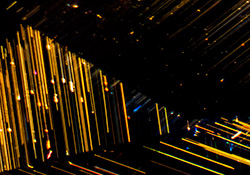
A discussion of rutile silk in corundum (ruby & sapphire) and its use in detecting artificial heat treatment. Careful examination of these "silk" inclusions can provide vital clues to unmask heated gems.
Virtually all gemologists are aware of the curved growth lines and gas bubbles in Verneuil (flame-fusion) synthetic corundum, but few understand exactly why they occur and how they are distributed in these stones. This article clarifies these important identifying features.

The examination of a yellow sapphire provides a lesson in the power of gemological microscopy.